


윤용진 교수 연구팀, 무전원 수화 반응 구동형 현장 진단(POC)용 DNA 분석 키트 개발
2026.03.24
admin
KAIST 기계공학과 윤용진 교수 연구팀이 별도의 외부 전력이나 복잡한 장비 없이 수화 반응(Hydration Reaction)만으로 구동되는 일회용 DNA 분석 시스템을 개발하고, 이에 대한 연구 결과를 생산 제조 분야 국제 학술지 International Journal of Precision Engineering and Manufacturing-Green Technology (Impact Factor: 5.6, 공동 1저자 장세은 박사과정)에 게재하였다.
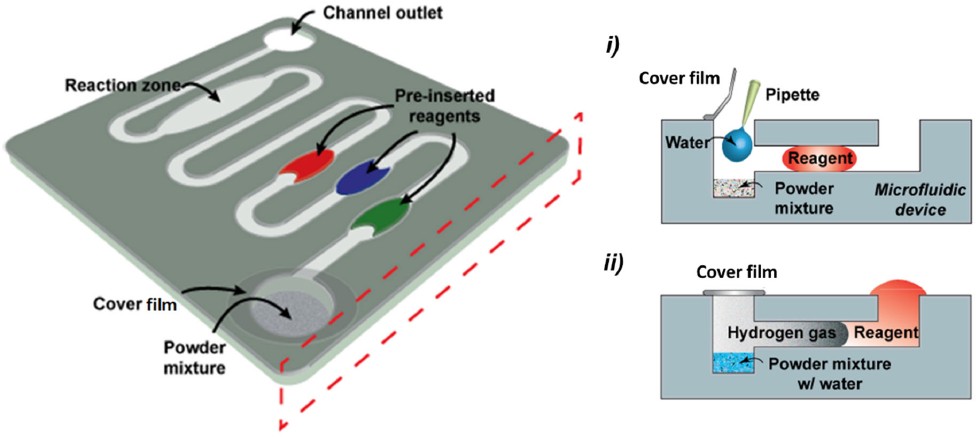
본 연구는 물과 분말의 화학 반응에서 발생하는 가스압과 반응열을 각각 유체 이송 동력원과 DNA 증폭을 위한 열원으로 활용하여, 시료의 전처리부터 등온 증폭(RPA), 검출에 이르는 전 과정을 1시간 이내에 수행할 수 있는 통합형 칩을 구현했다는 점에서 학술적 의의가 크다. 특히, 기존 수동형 펌프의 한계였던 짧은 구동 시간과 온도 제어의 부재를 독창적인 이중 기능 메커니즘으로 해결하여 현장 진단 기기의 실용성을 한 단계 높인 것으로 평가받는다.
연구팀은 본 논문에서 수화 반응의 정밀한 제어를 위해 분말과 물의 비율을 실험적으로 최적화하였으나, 향후 AI 기반의 설계 최적화(Generative Design) 기술을 도입한다면 유로의 저항과 반응 챔버의 열전달 효율을 고려한 최적의 칩 형상을 자동으로 도출할 수 있다. 또한, 대량 생산 시 발생할 수 있는 화학 반응 속도의 미세한 편차를 머신러닝 알고리즘으로 예측하고 보정하는 지능형 공정 제어 시스템을 구축함으로써, 일회용 진단 키트의 신뢰성과 생산 수율을 획기적으로 향상시킬 수 있는 가능성을 제시하였다.
윤용진 교수는 “이번 연구는 고가의 장비와 전문 인력이 필요한 기존 유전자 분석의 한계를 극복하고, 전력 공급이 어려운 환경에서도 정밀한 진단이 가능함을 입증한 데에 의의가 있다”며, “향후 이 플랫폼에 AI 기반의 진단 데이터 분석 및 제조 공정 최적화 기술이 결합된다면, 감염병 진단 등 다양한 헬스케어 분야에서 신속하고 정확한 의사결정을 지원하는 핵심 기술로 자리 잡을 것”이라고 밝혔다.

이 논문은 정부(산업통상자원부)의 재원으로 한국에너지기술평가원(KETEP)의 지원(No. 20194030202360) 및 정부(과학기술정보통신부)의 재원으로 한국연구재단(NRF)의 지원을 받아 수행된 연구임(No. 2020R1A2C1011859).
또한, 이 논문은 정부(산업통상자원부)의 재원으로 한국산업기술기획평가원(KEIT)의 지원을 받아 수행된 연구임(20023781).
본 연구는 과학기술정보통신부에서 지원하는 과학기술원 InnoCORE 사업에 의해 수행되었습니다(N10250154).
아울러, Ralph W. and Grace M. Showalter Research Trust (No. 41001449), Clifford B. Kinley Trust, 그리고 Purdue University의 Health of the Forces의 지원을 받아 수행되었습니다.
자세한 정보와 전체 논문은 International Journal of Precision Engineering and Manufacturing-Green Technology(https://doi.org/10.1007/s40684-025-00811-3)를 참조하세요.
The research team led by Professor Yong-Jin Yoon from the Department of Mechanical Engineering at KAIST, in collaboration with Ph.D. Student Saeeun Jang (Co-first author), has developed a disposable DNA analysis system driven solely by a hydration reaction, eliminating the need for external power or complex equipment. The results of this study were published in the International Journal of Precision Engineering and Manufacturing-Green Technology (Impact Factor: 5.6), an international journal in the field of production and manufacturing. This research is highly significant as it realizes an integrated chip capable of performing the entire workflow—from sample pretreatment to isothermal amplification (RPA) and detection—within one hour. This is achieved by utilizing the gas pressure and reaction heat generated from the chemical reaction between water and powder as the power source for fluid transport and the heat source for DNA amplification, respectively. Notably, the study is evaluated to have elevated the practicality of POC diagnostic devices to the next level by resolving the limitations of existing passive pumps, such as short operation times and the absence of temperature control, through a unique dual-function mechanism. While the research team experimentally optimized the powder-to-water ratio for precise control of the hydration reaction in this paper, they suggested that future implementation of AI-based Generative Design technology could automatically derive the optimal chip geometry, considering flow resistance and heat transfer efficiency of the reaction chamber. Furthermore, the team presented the potential to dramatically improve the reliability and production yield of disposable diagnostic kits by establishing an intelligent process control system that utilizes machine learning algorithms to predict and correct minute deviations in chemical reaction rates that may occur during mass production. Professor Yoon stated, "This study is significant in that it overcomes the limitations of existing genetic analysis, which requires expensive equipment and specialized personnel, and demonstrates that precise diagnosis is possible even in environments with limited power supply." He added, "If this platform is combined with AI-based diagnostic data analysis and manufacturing process optimization technologies in the future, it will establish itself as a key technology supporting rapid and accurate decision-making in various healthcare fields, including infectious disease diagnosis.
This work was supported by the Korea Institute of Energy Technology Evaluation and Planning (KETEP) and the Ministry of Trade, Industry & Energy (MOTIE) of the Republic of Korea (No. 20194030202360), the National Research Foundation of Korea (NRF) grant funded by the Korean government (MSIT) (No. 2020R1A2C1011859), Korea Evaluation Institute of Industrial Technology (KEIT) grant funded by the Korea Government (MOTIE) (20023781), InnoCORE program of the Ministry of Science and ICT(N10250154), Ralph W. and Grace M. Showalter Research Trust (No. 41001449), Clifford B. Kinley Trust, and Health of the Forces by Purdue University. For detailed information and the full paper, please refer to the International Journal of Precision Engineering and Manufacturing-Green Technology(https://doi.org/10.1007/s40684-025-00811-3)