


김태영 박사, 대한기계학회 마이크로/나노공학부문 2026 우수학위논문상 수상
2026.06.01
admin
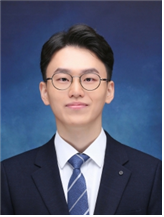
PRISM-AI InnoCORE 연구단 소속 김태영 박사후연구원 (지도교수: KAIST 기계공학과 이정철 교수)이 대한기계학회 마이크로/나노공학부문 우수학위논문상을 수상했다. 수상 학위논문의 제목은 「전역 및 국소 어닐링을 이용한 비전통적 마이크로/나노 제조에 관한 연구」로, 표면확산을 이용한 반도체 마이크로·나노 제조 기술의 독창성과 학문적·기술적 기여를 인정받았다.
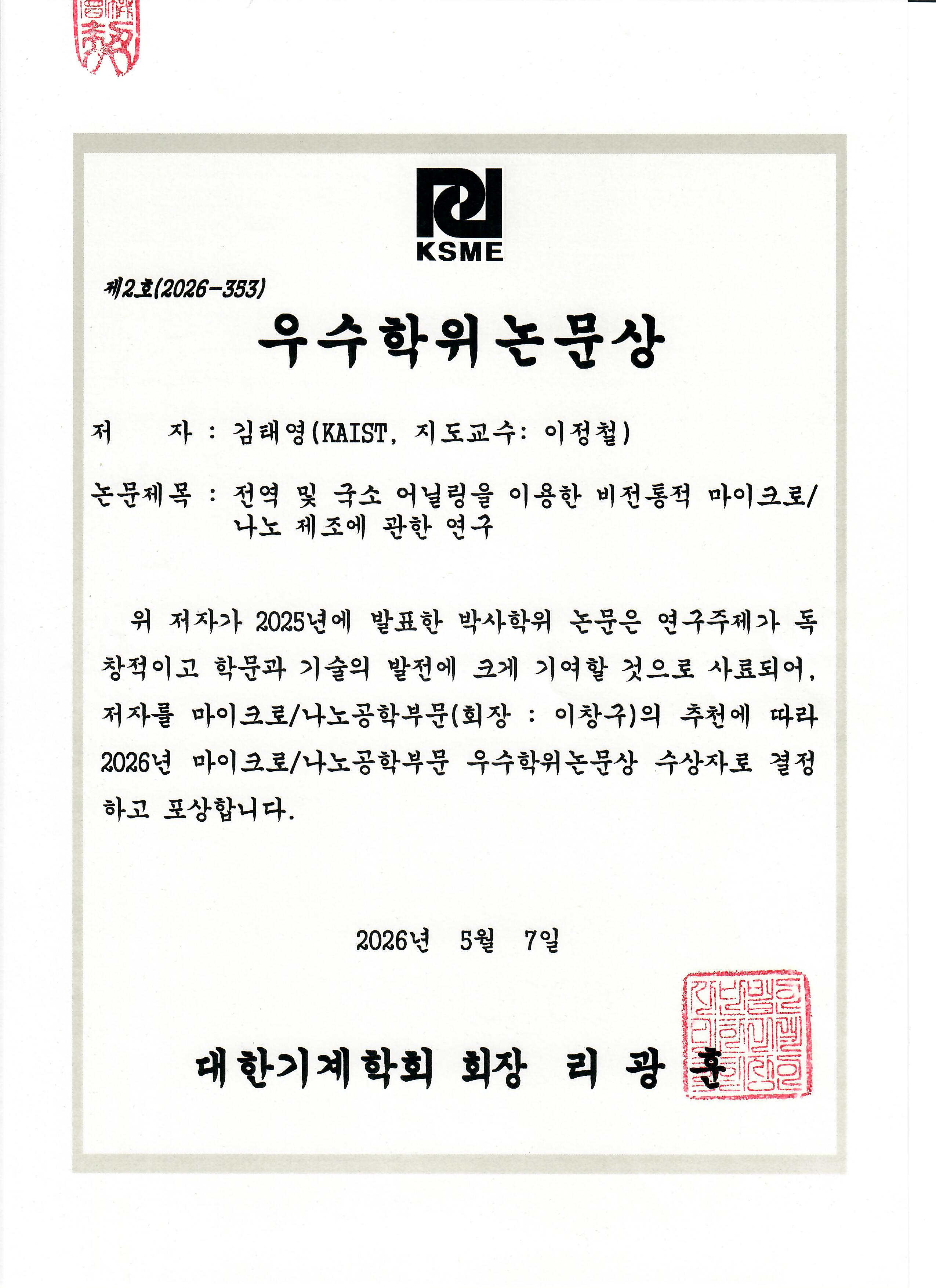
본 학위논문은 전자·광소자의 초미세화와 3차원 집적에 따라 증가하는 공정 복잡도와 비용을 해결하기 위해, 표면확산 기반 물리 설계와 전역·국소 어닐링을 결합한 새로운 제조 전략을 제시했다. 특히 공정 중 실시간 계측과 물리 모델을 이용해 표면확산 동역학을 정량화하고, 이를 나노구조 형상 설계의 근거로 활용함으로써 경험에 의존하던 어닐링 공정을 예측 가능한 제조 방식으로 발전시켰다.
이를 바탕으로 형상비가 제어된 실리콘 나노입자와 다층 실리콘 온 인슐레이터(SOI) 구조를 웨이퍼 규모로 구현했으며, 국소 레이저 어닐링을 이용해 유전체·플라즈모닉 서브나노미터 갭과 고감도 광학·분광 플랫폼을 개발했다. 또한 매개체 없는 에테르 전사 기술을 통해 0차원 나노입자와 2차원 나노박막을 이종 기판에 정렬·집적하며, 물성 정량화에서 형상 제어, 기능 구현 및 이종 집적까지 이어지는 통합 제조 체계를 확립했다.
이번 연구는 고가의 첨단 리소그래피와 복잡한 다단계 공정에 대한 의존도를 낮추면서 차세대 반도체, 나노광학 및 MEMS·NEMS 구조를 확장성 있게 제조할 수 있는 새로운 방향을 제시했다. 공정조건–확산 동역학–구조 형상–소자 기능을 연결한 정량적 데이터와 물리 모델은 향후 AI 기반 구조 역설계와 지능형 마이크로·나노 제조 연구의 기반이 될 것으로 기대된다.
Dr. Taeyeong Kim Receives the KSME Micro/Nano Engineering Division Outstanding Dissertation Award
Dr. Taeyeong Kim, a postdoctoral researcher affiliated with the PRISM-AI InnoCORE Research Center, received the Outstanding Dissertation Award from the Micro/Nano Engineering Division of the Korean Society of Mechanical Engineers. His doctoral dissertation, supervised by Professor Jungchul Lee at KAIST, is titled “A Study on Unconventional Micro-/Nanomanufacturing via Global and Local Annealing.”
The dissertation presents a physics-based manufacturing framework that combines quantitative surface-diffusion analysis with global and localized annealing. The framework was demonstrated through wafer-scale axis-ratio-controlled silicon nanoparticles, multilayer silicon-on-insulator structures, sub-nanometer dielectric and plasmonic gaps, and mediator-free transfer of zero- and two-dimensional nanostructures.
By linking diffusion kinetics, morphology control, functional devices, and heterogeneous integration, the study advances annealing-based fabrication from an empirical process to a predictive and scalable manufacturing strategy. The resulting physical models and quantitative datasets also provide a foundation for AI-assisted inverse design and intelligent micro- and nanomanufacturing.