


KAIST 이익진 교수, 2026 ACSMO 학회에서 데이터 융합 기반 위상 최적화 기조강연 및 ASSMO Award 수상
2026.07.15
admin
KAIST 기계공학과 이익진 교수가 2026년 아시아-태평양 구조 및 다분야 최적화 학회(ACSMO, Asian Congress on Structural and Multidisciplinary Optimization)에서 ‘데이터 융합 기법을 활용한 데이터 기반 모델링 및 위상 최적화 적용(Data-Driven Modeling with Data Fusion Technique and Its Application to Topology Optimization)’을 주제로 기조강의(Keynote Lecture)를 진행하였다. 또한, 구조 및 다분야 최적화 분야의 학문적 발전과 연구 성과에 대한 공로를 인정받아 아시아 구조 및 다분야 최적화 학회(ASSMO, Asian Society for Structural and Multidisciplinary Optimization)에서 수여하는 ASSMO Award를 수상하였다. 이번 기조강의는 아시아·태평양 지역의 최적설계 분야 연구자들과 학계 관계자들이 참석한 가운데 최신 데이터 기반 최적설계 연구 성과를 공유하는 자리로 마련되었다.
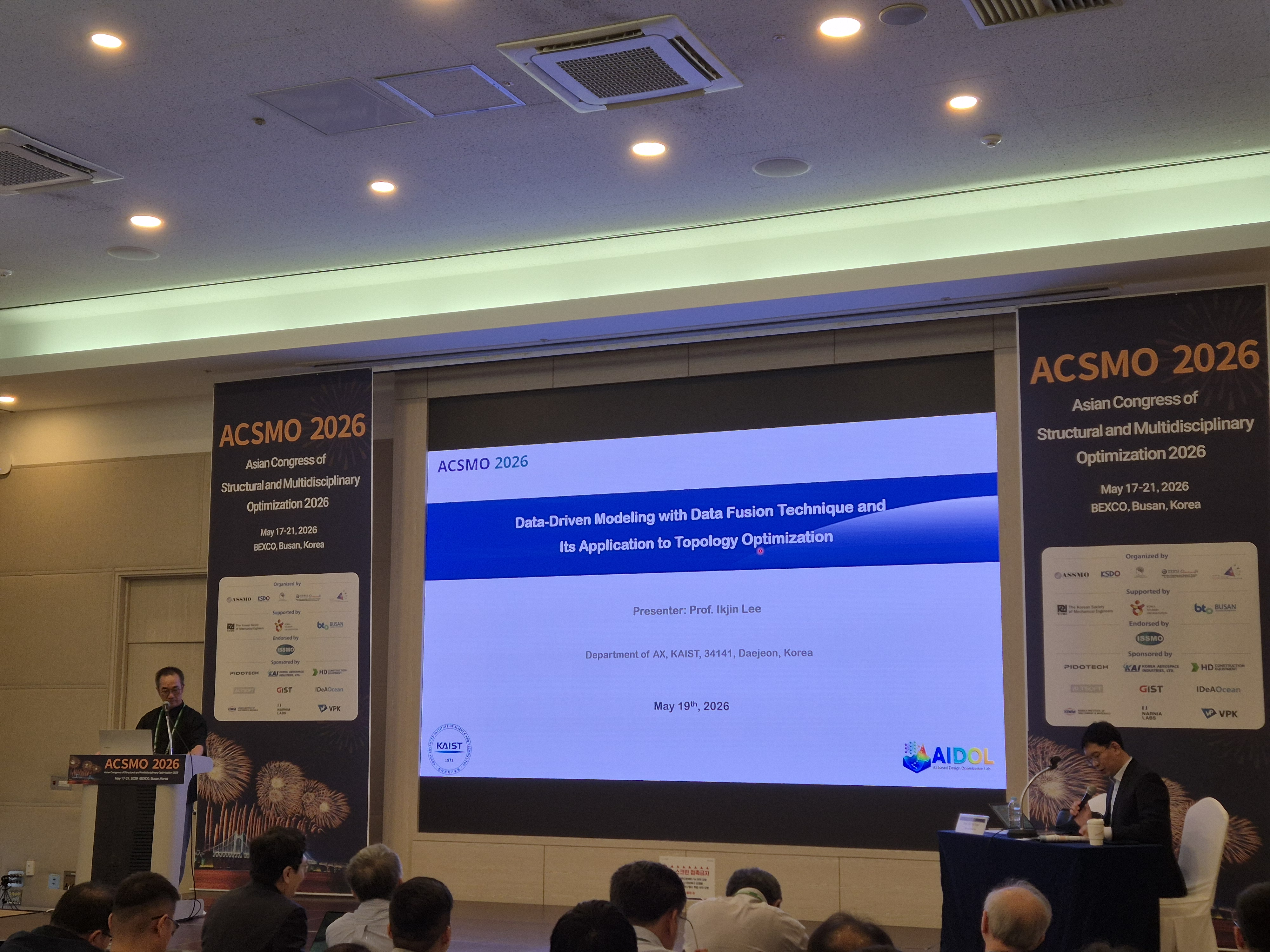
이익진 교수는 이번 발표에서 서로 다른 신뢰도를 가진 데이터 소스를 통합하여 복잡한 공학 시스템을 효율적으로 예측하는 ‘다중 신뢰도 데이터 융합’ 기반의 대리모델링 프레임워크를 소개하였다. 이 기술은 적응형 샘플링을 통해 고비용 시뮬레이션의 연산 부담을 최소화하는 방안으로 큰 주목을 받았다. 나아가 하이퍼파라미터 설정에 따라 국소 최적해에 빠지기 쉬운 위상 최적화 문제를 해결하기 위해 해당 프레임워크를 적용한 연구 성과도 함께 발표하였다. 조기 종료된 최적화 루프에서 얻은 저정밀 데이터와 완전히 수렴된 루프에서 얻은 고정밀 데이터를 다중 신뢰도 대리모델로 융합함으로써, 제한된 계산 비용 내에서도 전역 탐색 효율성과 최종 설계안의 품질을 크게 향상시킬 수 있음을 수치적 예제를 통해 입증하였다.
이번 기조강의와 ASSMO Award 수상은 인공지능과 데이터 기반 기법이 현대 공학 설계 및 최적화 분야의 패러다임을 어떻게 전환하고 있는지를 보여주는 뜻깊은 성과이다. 발표된 프레임워크는 기존 기법 대비 연산 비용을 대폭 절감하면서도 우수한 위상 설계안을 도출할 수 있어, 향후 고비용 시뮬레이션이 요구되는 첨단 제조, 항공우주 및 자동차 산업 분야에 실질적으로 기여할 수 있을 것으로 기대된다.\
KAIST 기계공학과와 대리모델 및 설계최적화 연구실은 이번 기조강의와 수상을 통해 아시아·태평양 지역의 연구 네트워크에서 한국의 최적설계 기술력과 연구 역량을 널리 알렸으며, 향후 이종 데이터 기반 자율 제조 및 최적화 분야의 공동 연구와 산학 협력을 더욱 공고히 해 나갈 계획이다.
KAIST Professor Ikjin Lee delivers keynote lecture on data fusion-based topology optimization and receives the ASSMO award at ACSMO 2026
Prof. Ikjin Lee of the Department of Mechanical Engineering at KAIST delivered a keynote lecture entitled “Data-Driven Modeling with Data Fusion Technique and Its Application to Topology Optimization” at the 2026 Asian Congress on Structural and Multidisciplinary Optimization (ACSMO). He also received the ASSMO Award, presented by the Asian Society for Structural and Multidisciplinary Optimization (ASSMO), in recognition of his academic contributions and research achievements in structural and multidisciplinary optimization. The keynote session brought together researchers and academic professionals from across the Asia-Pacific region to share recent advances in data-driven engineering design and optimization.
In his lecture, Professor Lee introduced a surrogate modeling framework based on multi-fidelity data fusion, which integrates data sources with different levels of fidelity to efficiently predict the behavior of complex engineering systems. The framework attracted significant attention as an effective means of reducing the computational burden associated with expensive simulations through adaptive sampling. He also presented research applying this framework to topology optimization problems that are prone to becoming trapped in local optima depending on hyperparameter settings. By combining low-fidelity data obtained from prematurely terminated optimization runs with high-fidelity data from fully converged runs, the multi-fidelity surrogate model was shown through numerical examples to improve both global search efficiency and the quality of the final design within a limited computational budget.
The keynote lecture and ASSMO award highlighted the transformative role of artificial intelligence and data-driven methodologies in modern engineering design and optimization. The presented framework can substantially reduce computational costs while identifying high-quality topology designs. It is therefore expected to contribute to a wide range of advanced manufacturing, aerospace, and automotive applications that require computationally intensive simulations.
Through this keynote lecture and award, the Department of Mechanical Engineering at KAIST and the Surrogate Modeling and Design Optimization Laboratory showcased Korea’s technological capabilities and research excellence in engineering optimization within the Asia-Pacific research community. The laboratory plans to further strengthen academic collaboration and industry partnerships in autonomous manufacturing and optimization based on heterogeneous data.