


제조 AI 기술 접목해 '숨은 위식도역류질환자' 가려내는 AI 보완 프레임워크 개발
2026.07.13
admin
KAIST 기계공학과 유승화 교수 연구팀의 이송호·이준형 박사는 나노종합기술원 이경균 박사, 연세대학교 세브란스병원 김희만 교수 연구팀과 공동으로, 24시간 다채널 임피던스-pH 모니터링 검사에서 음성으로 분류된 환자 중 추가적인 임상 재평가가 필요한 잠재적 위음성 후보를 선별하는 인공지능 기반 보완 프레임워크를 개발했다.
이번 연구는 기계·제조 분야에서 센서 신호를 분석해 설비의 비정상 상태나 고장 징후를 선별하는 이상탐지 개념을 의료 생체신호 분석으로 확장했다는 점에서 의미가 있다. 위식도역류질환의 표준 검사에서는 식도 내 산도가 pH 4 미만으로 유지된 시간의 비율인 산 노출 시간(AET)을 주요 지표로 사용한다. 그러나 검사 시간이 24시간으로 제한되어 있어 역류가 간헐적으로 발생하는 환자는 검사 중 충분한 산 노출이 관찰되지 않아 음성으로 분류될 가능성이 있다.
연구팀은 24시간 pH 신호에서 평균, 분산, 왜도, 첨도, 최대·최소 파형 차이 등 통계적·파형 기반 특징을 추출하고, 기존 임상 지표인 AET와 결합해 다차원 특징 벡터를 구성했다. 이후 비지도학습 기반 이상탐지 알고리즘인 OCSVM과 SVDD를 적용해 일반적인 신호 분포에서 벗어난 환자를 재평가 후보로 선별했다.
총 612명의 임상 데이터를 분석한 결과, 기존 AET 기준에서 음성으로 분류된 493명 중 108명인 21.9%가 추가 검토가 필요한 이상 사례로 선별됐다. 제안 모델은 재현율에 높은 가중치를 부여한 F₃ 점수에서 약 0.9의 성능을 보였다. 또한 모델 결과를 알지 못한 독립 전문의의 후향적 판독을 기준으로 평가했을 때, 테스트 세트에서 정확도 0.951, 재현율 1.000, F1 점수 0.929를 기록했다.
연구팀은 설명 가능한 AI 기법인 SHAP 분석을 도입해 AET뿐 아니라 첨도와 최대·최소 파형 차이 등의 특징이 각 환자의 이상 판정에 얼마나 기여했는지를 시각적으로 제시했다. 이를 통해 의료진은 AI의 판단 근거를 확인하고, 추가 검사나 추적 관찰이 필요한 환자를 우선적으로 검토할 수 있다.
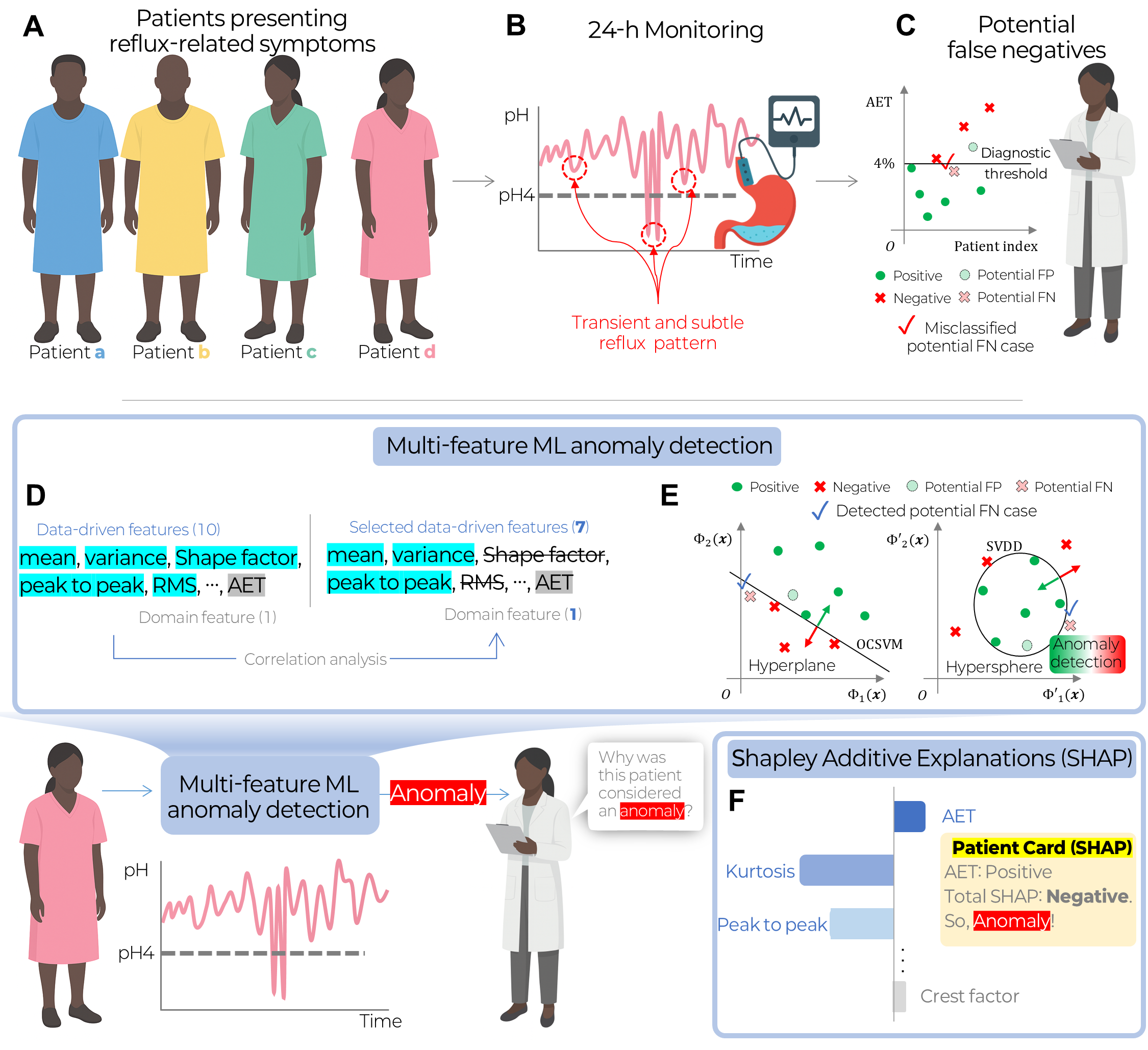
본 기술은 기존 위식도역류질환 진단 기준을 대체하거나 질환을 직접 확진하는 모델이 아니라, 기존 검사에서 음성으로 분류된 환자 중 추가적인 확인이 필요한 후보를 선별하는 임상 의사결정 보조 도구이다. 이번 성과는 제조 AI 분야에서 활용되어 온 센서 기반 이상탐지 기술이 디지털 헬스케어와 의료 AI 분야로 확장될 수 있음을 보여준다. 연구 결과는 디지털 헬스케어 분야 국제학술지 npj Digital Medicine에 2026년 5월 27일 게재됐다.
본 연구는 과학기술정보통신부 InnoCORE 프로그램(N10260002)과 과학기술정보통신부 재원의 한국연구재단 연구과제(RS-2025-00560250, RS-2024- 00416835, RS-2024-00442068) 의 지원을 받아 수행됐다.
Manufacturing-Inspired Anomaly Detection AI Supports Reassessment of Negative Gastroesophageal Reflux Tests
A joint research team led by Professor Seunghwa Ryu at KAIST, in collaboration with researchers from the National Nanofab Center and Severance Hospital, Yonsei University College of Medicine, developed a complementary artificial intelligence framework for identifying patients who may require further clinical reassessment after receiving negative results from 24-hour multichannel intraluminal impedance-pH monitoring.
The study extends anomaly detection approaches commonly used to identify abnormal sensor patterns in mechanical and manufacturing systems to the analysis of clinical biosignals. Although acid exposure time, or AET, is a principal index for gastroesophageal reflux disease assessment, the limited 24-hour monitoring window may fail to capture intermittent or low-frequency reflux events.
The researchers extracted statistical and waveform-derived features from 24-hour pH signals, including mean, variance, skewness, kurtosis, and peak-to-peak amplitude, and combined them with AET. Unsupervised anomaly detection models based on one-class support vector machines and support vector data description were then used to identify atypical signal patterns within the AET-negative cohort.
Among 493 patients classified as negative according to the conventional AET criterion, 108 patients, or 21.9%, were flagged as candidates for additional clinical reassessment. The framework achieved an F₃ score of approximately 0.9. When evaluated against retrospective assessments by an independent clinical expert blinded to the model outputs, it achieved an accuracy of 0.951, a recall of 1.000, and an F1 score of 0.929 on the test set.
The team also incorporated SHAP-based explainable AI to visualize how individual features contributed to each anomaly decision. The proposed framework is not intended to replace conventional diagnostic criteria or directly diagnose gastroesophageal reflux disease. Instead, it serves as a complementary decision-support tool that helps clinicians prioritize patients who may benefit from further evaluation. The study was published in npj Digital Medicine on 27 May 2026.